- Calling India a strategic higher education market, American universities expand dual degrees, pathways and future-ready models to tap Indian talent
Even as visa challenges and policy uncertainties reshape international student mobility, leading US business schools are recasting India as a strategic higher education market, underlining that the United States continues to depend on global—particularly Indian—talent.
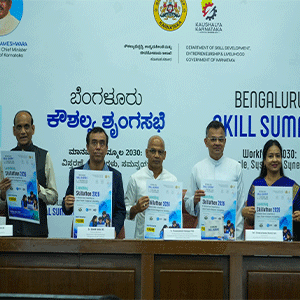
Speaking at ShiftEd 2026, hosted by GradRight, senior academic leaders said the current environment is pushing universities to move beyond traditional recruitment towards deep partnerships, dual degrees, pathway programmes and future-ready education models anchored in India.
India Becomes Central To Global Talent Pipelines
According to the new joint report by Knight Frank India, Deloitte India and QS Quacquarelli Symonds, India is poised to become the most strategically important destination globally for the expansion of international higher education, driven by a once-in-a-generation convergence of policy reform, demographic scale and urban readiness. The report says that global universities are now increasingly viewing India not just as a source of students but as a destination for long-term academic presence.
Having engaged with India over the past three years, Roberts said the country stands out due to its strong education ethic, English-language advantage and a unique blend of cultural and spiritual values. He also highlighted India’s economic trajectory, noting that global companies are increasingly establishing operations in the country to tap into its talent and cost advantages.
Against this backdrop, he said universities must go beyond recruitment and instead build programmes, partnerships and eventually physical or hybrid presence in India. Models under consideration include split-degree formats (part India, part US), fully local delivery and global multi-campus ecosystems spanning regions such as the US, Europe and the Middle East.
While cost structures remain a challenge, he indicated that institutions are actively working on financially viable models and partnerships to enable such expansion.
‘Leapfrogging’ The Future With AI-led Education
Roberts also called for a fundamental redesign of higher education in the age of artificial intelligence. Rather than incremental adoption, he argued that institutions must rethink the roles of faculty, students and assessment systems altogether.
He described this as a “leapfrog” opportunity—where India could help build next-generation education models that go beyond what is currently being implemented even in the US. This includes creating new types of degrees, delivery formats and learning experiences aligned with future workforce needs.
Such innovation, he suggested, requires collaboration with partners willing to experiment and build “out-of-the-box” systems, rather than replicating traditional structures.
Mike Mazzeo, Dean, Olin Business School, Washington University, said the institution’s decade-long partnership with IIT Bombay, through a joint Executive MBA, has already produced hundreds of senior leaders across India. He added that Indian students are increasingly enrolling across undergraduate, MBA and specialised master’s programmes, particularly in focused domains such as quantitative finance, supply chain, business analytics and accounting. These shorter, intensive programmes are designed to help students “level up” and transition into leadership roles.
Mazzeo emphasised that most of these programmes are Stem-designated, enabling graduates to work in the US for up to three years under OPT—an important employment pathway. He also noted that as technology reshapes industries, the premium on studying at top-ranked global institutions is rising, strengthening long-term return on investment.
Importantly, he framed the current dip in applications due to visa concerns as an opportunity. With fewer applicants, high-quality students from India could gain access to better institutions. “If others are stepping back, this is the time to go forward,” he indicated, urging students to “buck the trend.”
This comes as US President Trump announced a USD 100,000 H-1B visa fee on 19 September 2025 further complicating matters for Indian professionals and students exploring post-study work pathways. The Trump administration earlier said the USD 100,000 fee aims to ensure that entrants brought into the country are “highly skilled” and do not replace American workers.
At the same time, H-1B stamping appointments for Indian applicants have faced severe backlogs, with interview dates in some cases extending to 2027, according to some media reports. As a result International student enrolment in the US has reportedly declined by close to 5,000.
Structured Partnerships, Better Outcomes
Dietrich Tschanz, Associate Dean, International Programmes, Rutgers Business School, said the institution has significantly strengthened its India strategy through structured collaborations and ecosystem support.
Rutgers currently runs two 1+1 dual degree programmes with XLRI, Jamshedpur—in supply chain analytics and healthcare analytics—where students complete one year in India, including internships, before finishing their master’s in the US. This model, he noted, allows universities to be almost certain of student success and employability. Many participants already have work experience and internship exposure in India, and in some cases in the US, making them well-positioned for roles in the American system.
Looking ahead, Rutgers plans to expand with additional dual degree partnerships and pathway programmes, where undergraduate students can take master’s-level courses in advance and accelerate their degrees.
Tschanz also underlined a critical point on mobility: students must approach US education as non-immigrants during the visa process. While long-term career pathways may exist later, clarity on this distinction is essential for successful visa outcomes.
“Because students are non-immigrants, if they say they want to immigrate to the United States, they will be rejected. So, they can come on an F1 visa only if they pledge that after completing the program, which includes OPT, STEM OPT, if it’s part of the program, that they return to their country of origin. Now, some students can apply for a justice status through the H1B1, through marriage, in various ways, but that’s outside of the visa property,” he noted.
Visa Headwinds, But Strong Underlying Demand
While visa challenges and policy uncertainty were acknowledged, institutions remained optimistic about long-term trends. Since late 2025, the US H-1B visa regime has seen tighter rules, higher costs and growing unpredictability. Visa appointment wait times for B1/B2 categories have stretched up to 10 months, with backlogs reported across Mumbai, Kolkata and Hyderabad. These delays have increasingly affected academic admissions, employment offers and long-term migration plans.
Mazzeo noted that better articulation of academic goals and institutional fit can improve visa success rates. Tschanz highlighted the importance of understanding visa frameworks, while Roberts described current disruptions as temporary “turbulence” that will eventually stabilise.
Crucially, all three leaders converged on a common point: the United States needs international talent—and India remains central to that pipeline. The message was clear: while mobility may face friction, the demand for Indian talent remains intact—and is driving a structural shift in engagement.
Chell Roberts, Dean, Shiley-Marcos School of Engineering and Associate Provost, University of San Diego, positioned India not just as a student source but as one of the most important countries for the future of global education. “If you look at the makeup of big companies in the United States and you go to the Googles and the Apples and the Netflixes and all those in California, where I am, there are many, many Indians in those companies and many who are CEOs and leaders of those companies. And so my best friends in those companies come from India. And so there’s this natural maybe that’s been a brain drain. Some call it a brain drain that we’ve taken all these students from India and they’ve helped prop up our economy and build our companies. And that’s partly true. India’s been an important resource for the United States and building those things,” he noted.
“I want to bring part of our university to India. I would love to have a branch campus someday,” he added.