- The DET stands for the Duolingo English Test and is a fully digital English language proficiency exam, like traditional exams such as the IELTS or TOEFL.
All eight Ivy League universities in the United States, Canada’s U15 group of research‑intensive institutions, and UK universities, including Imperial College London and the University of Warwick, now accept the Duolingo English Test (DET) for admissions.
With more than 6,500 universities recognising the test, international students can apply to study in the US, UK, Canada, Australia, and more countries based on this test. Recent additions to the DET network include Utah State University, the University of Virginia School of Data Science, Bangor University, and the University of Exeter, further strengthening its international reach, states the press release.
What is DET?
The DET stands for the Duolingo English Test and is a fully digital English language proficiency exam, like traditional exams such as the IELTS or TOEFL. It is created for international students and professionals.
The test can be taken from home, at a time of the applicant’s choosing, and results will be shared in under 48 hours. Scores can be shared with an various number of institutions at no additional cost, with no test centre bookings or rigid scheduling windows required.
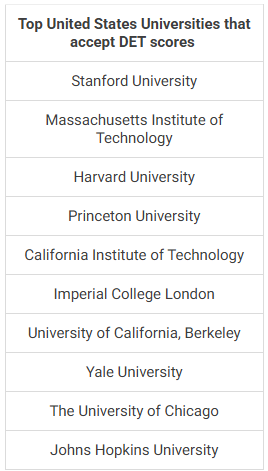
In Australia, institutions now accept Duolingo English Test (DET) scores for admissions. These include Monash University, the University of New South Wales, Macquarie University, the University of Newcastle, Deakin University, Griffith University, La Trobe University, RMIT University, Flinders University, and Edith Cowan University.
In Canada, institutions include the University of Toronto, McGill University, McMaster University, the University of Alberta, the University of Waterloo, the University of Ottawa, the University of Calgary, Western University, Queen’s University, and Simon Fraser University.
Rogelio Alvarez, Vice President and General Manager at Duolingo English Test, said, “More than a milestone, this reflects a meaningful shift in how universities think about access. When students have the flexibility to choose a test that is accessible, convenient, and affordable, language proficiency testing becomes a bridge rather than a barrier. We are grateful to our university partners worldwide for championing this vision.”